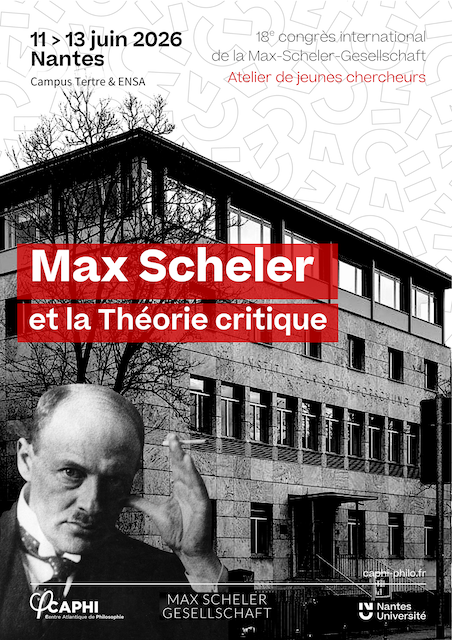
BIENNIAL INTERNATIONAL CONGRESS OF THE MAX SCHELER SOCIETY 2026
The relationship between Critical Theory, which emerged from the Frankfurt School, and Max Scheler (1874–1928) is multifaceted and complex. From a historical perspective, the Frankfurt School began by recognizing the importance of Scheler's philosophical renewal (Horkheimer 1928). Scheler's developments in psychology, phenomenology, and Lebensphilosophiewere extensively discussed by Max Horkheimer and Theodor W. Adorno in the 1920s and 1930s. The Frankfurt School—possibly partly under the influence of Siegfried Kracauer (Kracauer 1921; Agard 2006, 146-148)—then gradually distanced itself from the philosopher, through provocative statements such as Adorno's: “Scheler: The Boudoir in Philosophy” (Adorno 1951, 253). However, from a systematic point of view, Scheler's influence on Critical Theory is constant, however underground and little studied it may be (with the exception of G.Raulet's pioneering works on the subject: seeRaulet 2020). The aim of this symposium is to explore, as systematically and broadly as possible, the relationship between Scheler's thought and Critical Theory.
RESEARCH AXES OF THE CONGRESS
Historical and institutional relationships (Coomann 2021). The Institute for Social Research, founded in February 1923 in Frankfurt, had its “twin” in the Institute founded in 1919 in Cologne, where the currents of social psychology and the sociology of knowledge were represented (with Leopold von Wiese and Scheler). In 1928, Scheler was called to Frankfurt to fill the chair previously held by Hans Cornelius, who had supervised the doctoral theses of both Horkheimer and Adorno. Adorno's habilitation thesis was ultimately supervised not by Scheler but by Paul Tillich, who succeeded Scheler after the latter's early death. In several texts from the 1920s and 1930s, Horkheimer pays thorough tribute to Scheler's work.
Thematic relationships: Critique of modernity. Subtopic 1: Critique of instrumental rationality/ knowledge of domination. Critique of the domination of external and internal nature. Relationship to psychoanalysis. Subtopic 2: Critique of exploitative social relationships: exploitation and domination of humans by other humans in Critical Theory, self-exploitation in Scheler. Status and value of work in modern society.Subtopic 3: Scheler's phenomenology versus “immanent critique”. Relationship to metaphysics; different versions of the distinction between “normative” and “descriptive.” Subtopic 4: Philosophical anthropology and Critical Theory (Breuer 2016, in particular chapter 3, “Anthropology 3.0,” 97ff.; Fischer 2017, where the differences, and Thies 2018, where the similarities are highlighted). See in particular the critical discussion of Scheler's philosophical anthropology by Horkheimer (Horkheimer 1930, 1935) and by Adorno (in the last three texts ofAdorno 2003). For a rehabilitation of philosophical anthropology, particularly Scheler's, see Ebke et al. 2017; Schloßberger 2019; Raulet 2020.
Conceptual posterity. Subtopic 1: Resentment and recognition (see e.g.Guénard 2012). Subtopic2:Relationship to Scheler of the different generations and periods of the Frankfurt School: a) Are these relationships equally important for the recent School and for the classical School? b) Are they similar in the sense that they engage with the same themes and concepts?Subtopic 3: Critical uses of Schelerian phenomenology in different cultural contexts (outside the Frankfurt School).
 Loading...